
People keep describing Abu Dhabi to me as “Dubai but slower,” and every time I hear it, something in me winces a little. It undersells the place. Abu Dhabi isn’t a quieter version of its flashier neighbor — it’s the seat of Emirati governance and identity, the city where heritage sites do the talking instead of skyscrapers. You don’t photograph Abu Dhabi loudly. You walk through it quietly, and it rewards you for doing so.
Why Comparing It to Dubai Misses the Point
Dubai built its identity around spectacle — biggest, tallest, fastest. Abu Dhabi built its identity around permanence: a grand mosque meant to stand for centuries, a national museum designed to hold the country’s story, a presidential palace built to be walked through, not just looked at. If you arrive expecting Dubai’s energy, you’ll be disappointed. If you arrive expecting depth, you’ll leave with more than you came for.
The Sheikh Zayed Grand Mosque — Beyond the Photo Op
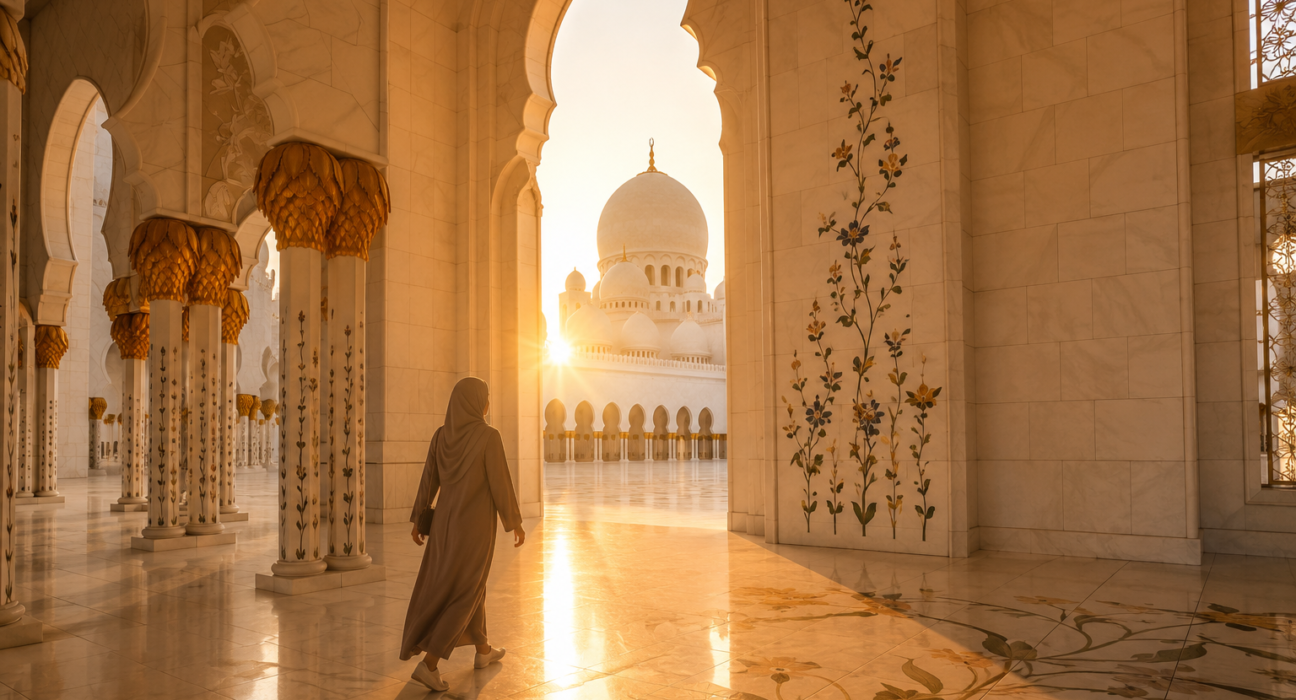
Almost everyone who visits the UAE ends up with a photo in front of this mosque. Far fewer actually experience it properly, because they treat it as a five-minute stop on a bus tour rather than the immersive space it’s designed to be.
A few practical notes that changed my visit for the better: women are provided a free abaya at the entrance if needed, and men need long trousers regardless of the heat outside — modest dress is enforced, not just suggested. The best time to visit is either right after the morning opening or shortly before sunset, when the tour buses have thinned out and the light hits the white marble at an angle that makes the whole courtyard glow.
Underfoot, in the main prayer hall, is the world’s largest hand-knotted carpet — a single, continuous piece that took two years and around 1,200 weavers to complete. Standing in the middle of it, looking up at the chandeliers overhead, is the kind of moment where you stop reaching for your phone for a full minute, which for a travel writer is saying something.
Packing/Prep Essentials for a Mosque Visit
- Loose, ankle-length clothing — even with an abaya provided, men need long trousers, not shorts.
- A scarf, even if not strictly required — respectful photos land better with covered hair, and it’s a small gesture of respect that’s noticed.
- Socks — the marble floors get genuinely hot at midday, and you’ll be walking barefoot inside.
Best Time to Visit vs. Budget Required
| Season | Crowd Level | Daily Budget (mid-range) | Notes |
| Nov–Feb | High (peak season) | AED 400–600 | Best weather, book museums ahead |
| Mar/Apr | Moderate | AED 300–450 | Warming up, still comfortable |
| May–Sep | Low | AED 200–350 | Brutal heat, but indoor culture (Louvre, Qasr Al Watan) still shines |
| Oct | Moderate | AED 300–400 | Shoulder season sweet spot |
If you’re heat-averse, don’t write off the summer months entirely — Abu Dhabi’s best cultural sites are almost all indoor and air-conditioned, which makes this an underrated time to visit if you’re comfortable trading beach weather for empty museum halls and lower hotel prices.
Louvre Abu Dhabi and Qasr Al Watan — The Underrated Pair
The Louvre Abu Dhabi gets attention for its architecture before its collection, and honestly, that attention is earned. The museum’s dome creates what’s often called a “rain of light” effect — sunlight filtered through a geometric pattern that shifts across the floor throughout the day. But the real achievement is curatorial: Islamic, Asian, and European art are displayed side by side deliberately, making an argument about shared human history rather than separating civilizations into isolated wings the way most museums do.
Qasr Al Watan, the presidential palace, gets skipped by most visitors in favor of Dubai’s malls, which is a genuine shame. Its library and gifting hall alone are worth the detour — a space built specifically to showcase gifts exchanged between the UAE and other nations, which ends up being a surprisingly candid window into the country’s diplomatic history.
From the Field
At the Louvre Abu Dhabi, I ended up trailing a museum guide for longer than I meant to — a young Emirati woman who’d studied art history in Paris and made the deliberate choice to come home and help build the narrative of this specific museum. I asked her, half out of curiosity and half just making conversation, why the curation mixed civilizations instead of separating them the way the Louvre in Paris does.
She paused for a second, like she’d been asked this before but still wanted to answer it properly. “Because the story isn’t really about East and West,” she said. “It’s about the same human ideas showing up in different places at different times.” That one line reframed the entire museum for me — I stopped walking through it as a collection of artifacts and started walking through it as an argument, one I found myself agreeing with by the time I reached the exit.