


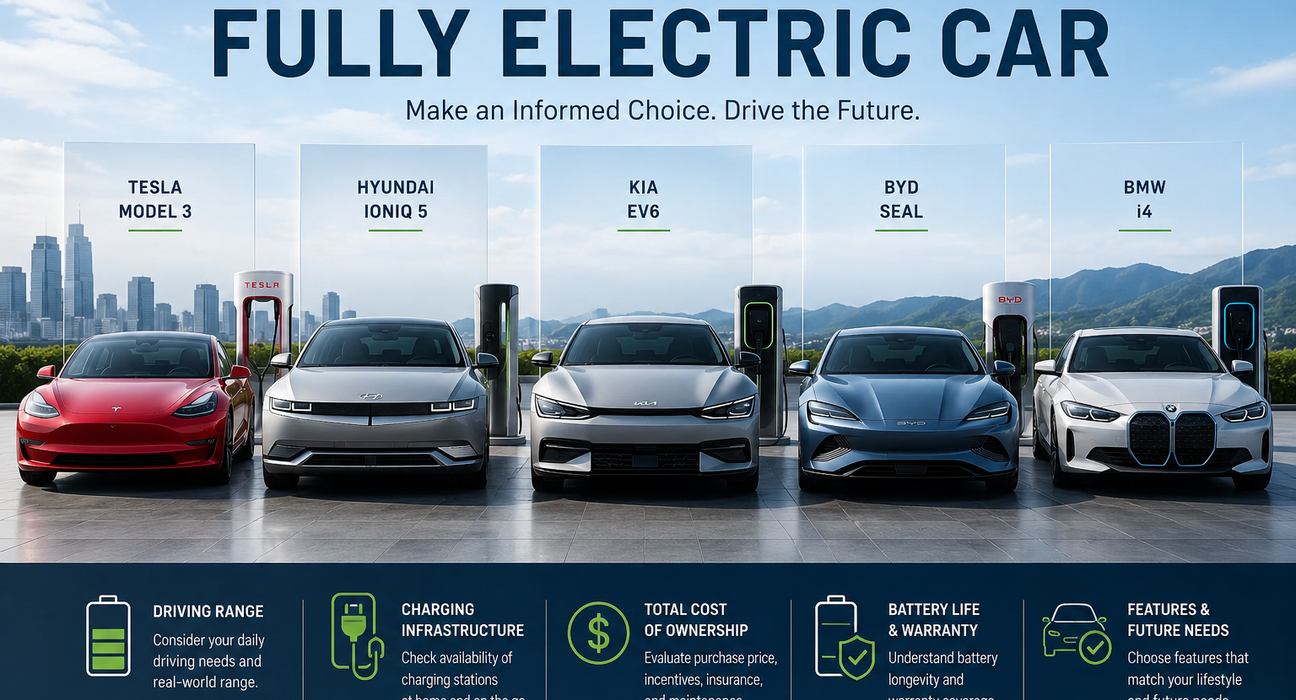
Buying a fully electric car is a major decision, and understanding the things to consider before buying a fully electric car can help you avoid expensive mistakes. From real-world driving range and charging options to battery health, ownership costs, safety and resale value, there are several factors worth evaluating before you sign a purchase agreement.
Electric vehicles (EVs) have become a mainstream choice for Australian motorists, with an expanding range of electric hatchbacks, sedans, SUVs and performance vehicles. But choosing the right EV involves much more than comparing battery capacity or the advertised driving range.
Table of Contents
1. Is a Fully Electric Car Right for Your Lifestyle?
The first question shouldn’t be **”Which electric car should I buy?”** It should be **”Does a fully electric car fit the way I actually live and drive?”** A fully electric vehicle, commonly called a BEV or battery electric vehicle, uses electricity stored in a battery to power one or more electric motors. Unlike a conventional hybrid or plug-in hybrid, it doesn’t have a petrol or diesel engine as a backup power source. That distinction makes your lifestyle particularly important. Your daily commute, parking arrangements, access to charging and frequency of long-distance travel can have a greater impact on EV ownership satisfaction than the vehicle’s badge or specification sheet.
1.1 How Many Kilometres Do You Drive Each Day?
Start with your **actual driving habits**, not your worst-case scenario. For example, if you drive 40–60 km on most weekdays and your car sits in the garage overnight, you may have plenty of opportunity to recharge before the next day’s commute. On the other hand, someone who regularly drives hundreds of kilometres each day needs to pay much closer attention to battery capacity, charging speed and public charging infrastructure. The Australian Government notes that the average Australian driver travels around 33 kilometres per day. For many motorists, this makes overnight charging a practical option. However, individual driving patterns vary considerably.
1.2 Where Do You Normally Drive?
Your driving environment matters because EV energy consumption changes according to speed, terrain, traffic and weather.
| Driving environment | Key EV consideration |
|---|---|
| City | Efficient stop-start driving and regenerative braking |
| Suburban | Convenient overnight home charging |
| Highway | Higher energy consumption at sustained speeds |
| Regional | Public charger availability |
| Remote | Charging redundancy and careful route planning |
| Frequent road trips | DC fast charging speed and network coverage |
1.3 Do You Need to Tow?
If you regularly tow a caravan, boat or trailer, don’t assume that the vehicle’s advertised range will remain unchanged. Towing increases both weight and aerodynamic drag. The result can be a substantial increase in energy consumption. Before purchasing, check the manufacturer’s specifications for towing capacity, payload, tow-ball limits and approved accessories.
1.4 Who May Not Be Ready for a Fully Electric Car?
A fully electric car may not be the best choice if you have no reliable charging option, frequently travel through remote areas or regularly tow heavy loads. That doesn’t mean an EV is unsuitable in general. It simply means the technology needs to match your lifestyle.
2. Calculate the Total Cost of Owning an EV
One of the biggest mistakes prospective EV buyers make is focusing exclusively on the vehicle’s purchase price. The more useful question is: **”How much will this vehicle actually cost me over five years?”** Your total cost of ownership can include the purchase price, finance, electricity, public charging, home charger installation, insurance, registration, servicing, tyres, repairs and depreciation. An EV may have lower energy and routine maintenance costs. However, that doesn’t automatically mean every EV will be cheaper to own than every petrol or hybrid vehicle.
2.1 Calculate the Purchase Cost
Start with the **drive-away price**, rather than the advertised headline price. Then consider:
- Vehicle purchase price.
- Finance interest.
- Registration.
- Insurance.
- Home charger.
- Electrical installation.
- Accessories.
- Optional equipment.
- Government incentives or applicable charges.
- Expected depreciation.
Always verify current Australian federal, state and territory incentives because EV policies, taxes and rebates can change.
2.2 Calculate EV Charging Costs
The basic calculation is straightforward: **Charging cost = Energy consumption × Electricity price** Suppose an EV consumes 18 kWh per 100 km and your electricity rate is $0.30 per kWh.
18 kWh × $0.30 = $5.40 per 100 km
If you drive 15,000 km per year, the theoretical electricity cost would be:
150 × $5.40 = $810 per year
This is an illustrative calculation. Actual costs can be higher because charging involves energy losses and electricity prices vary. Public charging can also cost considerably more than charging at home.
2.3 Compare EV Energy Costs With Petrol
For a petrol vehicle, you can use: **Fuel cost = Fuel consumption × Petrol price × Distance** For example, a petrol car consuming 7 L/100 km at $1.80 per litre would cost:
7 × $1.80 = $12.60 per 100 km
The comparison demonstrates why electricity costs can potentially provide significant running-cost savings. However, the complete ownership equation still needs to include purchase price, depreciation, insurance and servicing.
2.4 Are EVs Cheaper to Maintain?
Generally, EVs have fewer moving mechanical components than conventional internal-combustion vehicles. They don’t require traditional engine oil changes, spark plugs or many engine-related servicing procedures. However, EVs still require tyres, brake maintenance, brake fluid, cabin filters, suspension inspections, cooling-system checks, windscreen components and 12V battery maintenance.
2.5 Calculate Five-Year Total Cost of Ownership
| Cost category | Fully electric | Petrol | Hybrid |
|---|---|---|---|
| Purchase | $ | $ | $ |
| Electricity/fuel | $ | $ | $ |
| Servicing | $ | $ | $ |
| Insurance | $ | $ | $ |
| Registration | $ | $ | $ |
| Charging equipment | $ | N/A | Possible |
| Depreciation | $ | $ | $ |
| Five-year total | $ | $ | $ |
This calculation can completely change the buying decision. The cheapest EV isn’t necessarily the vehicle with the lowest purchase price. It is the vehicle that provides the best combination of purchase price, operating cost, practicality and resale value for your circumstances.
3. Understand Real-World EV Driving Range
Driving range is one of the most searched and discussed aspects of electric vehicles. But advertised range isn’t the same as real-world range. Official testing provides a standardised way to compare vehicles. Your actual range depends on how, where and when you drive.
3.1 What Does Advertised EV Range Mean?
Australian EV range figures are commonly based on the WLTP testing methodology. The figure is useful for comparing vehicles. It shouldn’t be interpreted as a guaranteed distance in every driving condition.
3.2 What Reduces EV Range?
- High-speed highway driving.
- Strong headwinds.
- Steep hills.
- Heavy vehicle loads.
- Towing.
- Aggressive acceleration.
- Low tyre pressure.
- Heating.
- Air conditioning.
- Extreme temperatures.
- Traffic conditions.
- Battery temperature.
3.3 How Much Range Do You Actually Need?
Don’t automatically buy the largest battery available. Instead, consider your normal daily distance, longest regular journey, charging opportunities and the buffer you want for unexpected trips. If you drive 50 km per day and charge at home every night, a very long-range EV may provide little practical benefit. If you regularly travel 400 km between charging opportunities, range and charging infrastructure become far more important.
3.4 Range Anxiety vs Range Planning
Modern EV ownership is increasingly about **range planning** rather than simply having the biggest possible battery. A driver who knows where the next reliable charger is located can often travel confidently with a smaller battery than someone who has no charging strategy.
4. Evaluate Your Charging Options
Charging is arguably the most important practical consideration before buying an EV. Petrol vehicles are usually refuelled in a few minutes. EVs can take significantly longer. However, an important difference is that you can often charge an EV while doing something else, particularly when charging at home overnight. The Australian Government reports that a large majority of EV charging occurs at home. This makes home charging one of the most important factors when evaluating whether an EV suits your lifestyle.
4.1 Can You Charge an EV at Home?
You can generally charge an EV using a suitable household power outlet or a dedicated wall charger. A standard household outlet is slower but can be adequate for drivers with relatively low daily mileage. A dedicated AC wall charger can provide substantially faster charging.
4.2 Do You Need a Dedicated EV Charger?
Not necessarily. A dedicated charger becomes more attractive if you drive significant distances each day, want faster overnight charging or want to integrate charging with solar generation and smart electricity tariffs. A licensed electrician should assess the home’s electrical infrastructure before installing a high-power charger.
4.3 What If You Live in an Apartment?
Apartment and strata living can make EV charging more complicated. You may need approval from your owners corporation, strata manager or landlord. You also need to consider dedicated parking, electricity metering, cable routing, load management and installation costs.
4.4 How Important Is Public Charging?
Public charging becomes increasingly important when home charging isn’t available or when you’re travelling long distances.
Don’t simply ask how many chargers exist in Australia.
Ask:
“Are there reliable chargers on the routes I actually use?”
Check:
- Charger locations.
- Charger speed.
- Charging prices.
- Payment methods.
- Network availability.
- Reliability.
- Backup charging locations.
- Highway coverage.
- Workplace charging.
- Destination charging.
5. Understand EV Battery Life and Degradation
The battery is arguably the most important component to understand before buying a fully electric car. Modern EV batteries are engineered for long service lives. However, batteries do gradually lose capacity over time. Battery degradation is therefore a more useful concept than simply asking whether an EV battery will “die.”
5.1 What Is Battery Degradation?
Battery degradation means the battery gradually loses some of its original energy-storage capacity. Imagine an EV originally capable of travelling 450 km under a particular test condition. After years of use, its usable battery capacity may decline. The vehicle can still operate normally. It simply may not travel quite as far between charges.
5.2 What Affects Battery Health?
- Battery chemistry.
- Temperature.
- Charging behaviour.
- Charging frequency.
- High-power DC charging.
- Depth of discharge.
- Vehicle age.
- Thermal management.
- Battery-management software.
- Manufacturer design.
Always follow the vehicle manufacturer’s charging recommendations because optimal charging practices can vary between battery chemistries and vehicle models.
5.3 How Long Do EV Batteries Last?
Modern lithium-ion EV batteries are designed to operate for many years. Battery warranties commonly extend for around eight years or a specified kilometre limit, although the exact terms differ between manufacturers. Some batteries can remain useful well beyond their original warranty period. The important point is that **battery warranty length, degradation limits and actual battery health should be evaluated together**.
5.4 What Does Battery Replacement Cost?
There isn’t one universal EV battery replacement price. Costs can vary according to battery size, chemistry, vehicle model, parts availability, labour and whether the problem requires an entire pack or a repair to specific components. If you’re buying a used EV, investigate the battery warranty and ask whether a battery-health assessment is available.
6. Understand EV Battery Technology
Not every EV battery is identical. Different battery chemistries have different characteristics involving energy density, cost, thermal behaviour and charging requirements. Two battery chemistries that buyers commonly encounter are **LFP**, or lithium iron phosphate, and **NMC**, or nickel manganese cobalt.
6.1 LFP vs NMC Batteries
| Characteristic | LFP | NMC |
|---|---|---|
| Energy density | Generally lower | Generally higher |
| Common advantage | Cost and durability characteristics | High energy density |
| Chemistry | Lithium iron phosphate | Nickel manganese cobalt |
| Vehicle application | Manufacturer-dependent | Manufacturer-dependent |
| Charging strategy | Vehicle-specific | Vehicle-specific |
Battery chemistry alone shouldn’t determine your purchase. The battery-management system, thermal management, warranty, charging characteristics and overall vehicle efficiency are equally important.
7. Compare EV Charging Speeds
Charging speed is another area where EV marketing can create confusion. A vehicle might advertise a maximum DC charging rate of 200 kW or more. That doesn’t mean the car will continuously charge at that speed.
7.1 AC Charging
AC charging is common for home, workplace and destination charging. Dedicated AC charging systems can typically provide charging at approximately 7 kW, 11 kW or 22 kW depending on the charger, electrical installation and vehicle’s onboard charger.
7.2 DC Fast Charging
DC fast charging can provide considerably more power than normal AC charging. This makes it particularly useful for highway travel. However, the vehicle’s maximum charging rate isn’t the only specification that matters.
7.3 Understand the Charging Curve
Charging power typically changes during a charging session. A vehicle may accept high power when the battery has a low state of charge and gradually reduce charging power as the battery becomes fuller. This is known as **charging taper**. Therefore, a vehicle advertising 250 kW peak charging isn’t necessarily faster overall than a vehicle rated at 180 kW. For road trips, investigate the vehicle’s charging curve and typical 10–80% charging time.
8. Consider Australia’s Climate and Driving Conditions
Australia’s climate ranges from tropical heat to alpine conditions. Temperature can influence EV energy consumption, charging performance and battery thermal management.
8.1 How Does Heat Affect EVs?
High temperatures can increase the energy required for cabin cooling and battery thermal management. When comparing EVs, investigate the vehicle’s thermal-management system and whether it includes technologies such as battery liquid cooling or a heat pump.
8.2 What About Cold Weather?
Cold temperatures can temporarily affect battery performance and increase energy consumption. Cabin heating can also consume additional energy. This becomes particularly relevant for drivers who regularly travel through Australia’s colder regions.
8.3 What About Rain and Flooding?
Modern EVs are designed for normal wet-weather driving. Floodwater is a completely different matter. Never assume that an EV can safely drive through floodwater simply because its propulsion system is electric. Always follow manufacturer guidance and road-safety warnings.
9. Understand EV Servicing and Maintenance
Electric motors have fewer moving mechanical components than internal-combustion engines. That can simplify routine maintenance. However, an EV isn’t maintenance-free.
9.1 What Maintenance Does an EV Need?
- Tyre inspections and replacement.
- Brake-system checks.
- Brake-fluid replacement.
- Cabin-filter replacement.
- Suspension inspection.
- Steering-system inspection.
- Cooling-system maintenance.
- 12V battery replacement when required.
- Windscreen and wiper maintenance.
- Software and system updates.
9.2 Are EV Repairs More Expensive?
Routine maintenance may be cheaper, but specialised repairs can be expensive. Potentially costly components include battery packs, inverters, power electronics, charging systems and electric motors. This is why the availability of qualified technicians and manufacturer support should be part of your buying decision.
10. Check Insurance, Registration and Hidden Costs
Insurance is one of the most frequently overlooked costs when people calculate EV ownership. Don’t assume that an EV will automatically be cheaper or more expensive to insure. Insurance premiums can depend on the vehicle, repair costs, parts availability, driver profile, location and insurer. Get an insurance quote **before buying the vehicle**.
10.1 Hidden EV Costs to Consider
- Home charger.
- Electrical upgrades.
- Electricity.
- Public charging.
- Insurance.
- Registration.
- Tyres.
- Accessories.
- Software subscriptions.
- Repairs.
- Depreciation.
These costs can significantly change the total ownership equation.
11. Consider EV Depreciation and Resale Value
Depreciation is potentially one of the largest costs associated with vehicle ownership. EV resale values can be influenced by rapidly changing battery technology, new model releases, changing prices, increased competition and consumer concerns about battery condition.
11.1 Why Can EVs Depreciate Quickly?
- Rapid technology improvements.
- Falling prices of newer models.
- Increased competition.
- Changing government incentives.
- Improved battery ranges.
- Faster charging technology.
- Consumer concerns about battery health.
- Changes in market demand.
11.2 What Can Influence EV Resale Value?
Battery health, remaining warranty, driving range, DC charging capability, safety technology, software support, service history and manufacturer reputation can all influence the attractiveness of a used EV.
12. Understand EV Safety and Cybersecurity
Modern EVs aren’t simply cars with electric motors. They are highly connected computing platforms containing sensors, communication systems, software, cloud services and mobile applications. That makes cybersecurity an increasingly important consideration for EV buyers.
12.1 Are Electric Cars Safe?
Modern EVs incorporate extensive safety engineering, including high-voltage isolation, battery monitoring, thermal management and crash protection. Battery fire risk should be considered objectively rather than through sensational headlines. The Australian Government has stated that overseas evidence indicates EVs are less likely to catch fire than petrol or diesel vehicles.
12.2 What Is Battery Thermal Runaway?
Thermal runaway occurs when a battery cell enters an uncontrolled self-heating reaction that can potentially propagate to nearby cells. Modern battery-management systems use temperature sensors, electrical monitoring, cooling systems and protective mechanisms to reduce these risks.
12.3 Can an EV Be Hacked?
Yes. Connected vehicles have cybersecurity attack surfaces. Potential targets include mobile applications, user accounts, Bluetooth, Wi-Fi, telematics, cloud platforms, charging infrastructure, vehicle APIs and software-update systems. This doesn’t make EVs inherently unsafe. It means cybersecurity has become another dimension of vehicle ownership.
12.4 EV Cybersecurity Buyer Checklist
- Does the manufacturer support multi-factor authentication?
- How frequently does it issue security updates?
- How long will software support continue?
- Can you control connected services?
- What vehicle data is collected?
- Can accounts be secured independently?
- Does the manufacturer provide vulnerability reporting?
- Are OTA updates digitally secured?
- What happens if connected services are discontinued?
- Can previous owners retain account access?
13. Consider Software and Connected-Car Technology
Software increasingly determines how modern EVs behave. Over-the-air updates can improve infotainment, navigation, battery-management functions, security and sometimes vehicle capabilities. That convenience creates another long-term ownership question: **How long will the manufacturer support this vehicle?**
13.1 What Are Over-the-Air Updates?
Over-the-air updates allow manufacturers to distribute software updates remotely instead of requiring every update to be installed at a dealership. This can improve convenience and reduce service visits.
13.2 Could Features Become Subscriptions?
Some manufacturers offer connected services or premium features through subscription models.
Before buying, check whether important functions depend on:
- Mobile connectivity.
- Premium subscriptions.
- Cloud services.
- Paid navigation.
- Remote-control services.
- Ongoing software subscriptions.
A feature that works today may have different commercial conditions later.
14. Compare EVs With Petrol and Hybrid Cars
A fully electric car isn’t automatically the best choice for every driver. The right comparison is based on your lifestyle, driving distance, charging access and budget.
14.1 EV vs Petrol Car
| Factor | EV | Petrol |
|---|---|---|
| Energy source | Electricity | Petrol |
| Tailpipe emissions | Zero | Yes |
| Routine maintenance | Generally lower | Generally higher |
| Refuelling | Charging | Fast refuelling |
| Home energy opportunity | Yes | No |
| Long-distance convenience | Depends on charging | Generally high |
| Mechanical complexity | Generally lower | Generally higher |
14.2 EV vs Hybrid
| Factor | Fully electric | Hybrid |
|---|---|---|
| Petrol engine | No | Yes |
| External charging | Yes | Usually no for conventional hybrid |
| Electric driving | Entire journey | Limited |
| Long-distance refuelling | Charging network | Petrol network |
| Tailpipe emissions | Zero | Yes |
| Mechanical complexity | Generally lower | Higher |
14.3 Which Powertrain Is Best?
**A fully electric vehicle may suit you if you have reliable charging, predictable daily driving, want potentially lower routine running costs and are comfortable planning longer journeys around charging infrastructure.** **A hybrid may suit you if you want better fuel efficiency while retaining the convenience of petrol refuelling.** **A petrol vehicle may remain practical if you regularly travel remote routes, tow heavily or have no reliable charging option.** There is no universal winner. The best powertrain is the one that fits your circumstances.
15. Check the Vehicle and Battery Warranty
Never buy an EV without reading its warranty conditions. Don’t simply ask how many years the warranty lasts. Read what the manufacturer actually promises.
15.1 What Warranties Should You Compare?
- Vehicle warranty.
- Battery warranty.
- Electric motor warranty.
- High-voltage component warranty.
- Corrosion warranty.
- Roadside assistance.
- Charging-equipment warranty.
15.2 What Does the Battery Warranty Guarantee?
Check the warranty’s duration, kilometre limit and minimum battery-capacity guarantee. Also determine whether the warranty transfers to subsequent owners. These details can become extremely important when buying a used EV.
15.3 Understand Australian Consumer Law
Manufacturer warranties aren’t the only protection available to Australian consumers. Australian Consumer Law provides automatic consumer guarantees for products and services. These guarantees operate separately from voluntary manufacturer warranties. Before purchasing an expensive vehicle, understand both the manufacturer’s warranty and your statutory consumer rights.
16. Buying a New vs Used Electric Car
Buying a used EV can provide significant value because the first owner may have already absorbed some depreciation. However, battery condition and remaining warranty become more important.
16.1 Advantages of Buying New
- Latest battery technology.
- Full manufacturer warranty.
- Latest safety features.
- Latest software.
- Latest charging capabilities.
- No unknown previous owner.
- Greater choice of specifications.
16.2 Advantages of Buying Used
- Lower purchase price.
- Depreciation already absorbed.
- Potentially better value.
- Access to higher specifications at a lower price.
16.3 Used EV Inspection Checklist
- Battery health.
- Remaining battery warranty.
- Charging performance.
- Service history.
- Accident history.
- Tyre condition.
- Suspension.
- 12V battery.
- Charging cables.
- Software version.
- Signs of water damage.
- Evidence of major repairs.
An independent inspection can be particularly worthwhile when purchasing a used EV.
17. Don’t Ignore EV Weight and Tyres
Battery packs add substantial weight to many electric vehicles. That additional weight and the instant torque of electric motors can influence tyre wear. Tyres can therefore become a surprisingly important part of EV ownership costs.
17.1 What Should You Check?
- Tyre size.
- Load rating.
- Recommended tyre specifications.
- Replacement cost.
- Availability.
- Expected lifespan.
- Rolling resistance.
- Noise characteristics.
Large wheels may look attractive, but replacement tyres can be considerably more expensive. When comparing EVs, check the price of replacement tyres before buying.
18. Evaluate Your Home Electricity Setup
If you charge at home, your EV becomes another significant electrical load within your household. Before purchasing a dedicated charger, have the electrical installation assessed by a licensed electrician.
18.1 Can Your Electrical System Support EV Charging?
Check:
- Switchboard capacity.
- Existing electrical loads.
- Electrical supply.
- Charger power.
- Cable routing.
- Safety requirements.
- Installation location.
- Potential future electrical loads.
18.2 Should You Charge During Off-Peak Periods?
If your electricity retailer offers time-of-use pricing, scheduled overnight charging may reduce the cost of charging. Smart chargers can help automate charging according to electricity prices or household energy demand.
18.3 Can Solar Panels Reduce EV Charging Costs?
If your home has solar panels, charging your EV during periods of solar generation can potentially reduce the amount of electricity you purchase from the grid. Some EVs and charging systems also support bidirectional charging technologies such as Vehicle-to-Load (V2L), Vehicle-to-Home (V2H) and Vehicle-to-Grid (V2G). However, compatibility between the vehicle, charger, electrical system and energy retailer needs to be confirmed before relying on these features.
19. Think About Long-Term Ownership
Don’t evaluate an EV only according to what it offers on the day you buy it. Consider your expected ownership period. If you’re keeping the vehicle for two or three years, depreciation and resale value deserve significant attention. If you’re planning to keep it for eight or ten years, battery warranty, long-term software support and servicing become much more important.
19.1 How Long Will You Keep the Car?
| Ownership period | Important considerations |
|---|---|
| 1–3 years | Depreciation, resale value and warranty |
| 3–5 years | Battery health, servicing and technology |
| 5–8 years | Battery warranty and long-term software |
| 8+ years | Battery longevity, repairs and manufacturer support |
19.2 Should You Wait for Better EV Technology?
EV technology will continue improving. Battery capacity, charging speeds, efficiency, software and driver-assistance systems will evolve. But waiting indefinitely for the next technological breakthrough can become counterproductive. If an EV meets your requirements today, fits your budget and offers reasonable long-term support, there may be little reason to wait simply because a better model will eventually appear.
20. Complete EV Pre-Purchase Checklist
Before signing the purchase agreement, work through the following checklist.
20.1 Financial Checklist
- Confirm the drive-away price.
- Compare finance rates.
- Obtain an insurance quote.
- Check registration costs.
- Calculate electricity costs.
- Calculate public charging costs.
- Obtain a home charger installation quote.
- Check servicing costs.
- Check tyre costs.
- Estimate depreciation.
- Calculate five-year ownership cost.
20.2 Charging Checklist
- Confirm home charging availability.
- Check electrical capacity.
- Compare home chargers.
- Identify nearby public chargers.
- Check workplace charging.
- Map your regular long-distance routes.
- Check DC charging capability.
- Check AC charging capability.
- Check charging connector compatibility.
- Compare charging prices.
20.3 Vehicle Checklist
- Check real-world range.
- Check battery capacity.
- Identify battery chemistry.
- Read the battery warranty.
- Read the vehicle warranty.
- Check charging speed.
- Research the charging curve.
- Check safety ratings.
- Check towing capacity.
- Check boot capacity.
- Check tyre costs.
- Check software support.
20.4 Lifestyle Checklist
- Calculate your average daily kilometres.
- Calculate your maximum regular journey.
- Consider road trips.
- Check charging along your regular routes.
- Confirm parking arrangements.
- Consider apartment or strata requirements.
- Consider your local climate.
- Consider family requirements.
- Consider towing requirements.
- Decide how long you intend to own the vehicle.
21. Frequently Asked Questions About Buying a Fully Electric Car
21.1 What Should I Consider Before Buying an Electric Car?
The most important things to consider before buying a fully electric car are daily driving distance, charging access, real-world range, electricity costs, battery warranty, servicing, insurance, depreciation and long-distance travel requirements. You should also compare charging speed, safety technology, software support and the vehicle’s total five-year ownership cost.
21.2 Is Buying a Fully Electric Car Worth It?
A fully electric car can be worth buying when its range and charging requirements match your lifestyle. Drivers with convenient home charging and predictable daily journeys may benefit from lower energy and routine maintenance costs. However, drivers without reliable charging or those who frequently travel remote routes should carefully compare an EV with a hybrid or petrol vehicle.
21.3 What Are the Disadvantages of Buying an Electric Car?
Potential disadvantages include higher upfront prices for some models, charging time, dependence on charging infrastructure, variable real-world range, depreciation and potentially expensive repairs involving high-voltage components. The severity of these disadvantages depends heavily on the vehicle and how you use it.
21.4 How Long Do EV Batteries Last?
Modern EV batteries are designed to operate for many years. Actual lifespan depends on battery chemistry, temperature, charging behaviour, usage patterns and the manufacturer’s battery-management system. Many manufacturers provide battery warranties lasting around eight years or a specified kilometre limit, although exact terms vary.
21.5 Can I Charge an EV at Home Without a Wall Charger?
Yes. A suitable household power outlet can charge an EV. However, charging will generally be slower than using a dedicated wall charger. For drivers with low daily kilometres, overnight charging from a household outlet may be sufficient. Higher-mileage drivers may benefit from a dedicated charger.
21.6 How Much Does It Cost to Charge an Electric Car?
The basic calculation is energy consumption multiplied by electricity price. For example, an EV consuming 18 kWh per 100 km at $0.30 per kWh would theoretically cost $5.40 per 100 km before charging losses. Actual costs depend on your electricity tariff, charging losses and whether you use home or public charging.
21.7 Are Electric Cars Expensive to Maintain?
EVs generally require less routine maintenance because they have fewer moving mechanical components than petrol or diesel vehicles. However, they still require tyres, brake maintenance, filters, suspension checks, cooling-system maintenance and other servicing. Major repairs involving batteries, power electronics or high-voltage components can be expensive.
21.8 Should I Buy an EV or Hybrid?
An EV may be better if you have convenient charging and predictable driving requirements. A hybrid may be more practical if you frequently travel long distances and want the convenience of petrol refuelling. The best choice depends on your driving pattern rather than a blanket assumption that one technology is always superior.
21.9 Are Electric Cars Suitable for Australian Road Trips?
Yes. Many EVs are capable of long-distance travel across Australia. However, road trips require more planning because charging stops need to be incorporated into the journey. Check charger locations, charging speed, reliability, payment requirements and backup charging options before starting a long trip.
21.10 Are Electric Cars Safe?
Modern EVs use extensive safety systems designed to protect occupants and manage high-voltage battery systems. Australian Government information indicates that overseas evidence suggests EVs are less likely to catch fire than petrol or diesel vehicles. However, EV safety should still be evaluated using independent crash ratings, manufacturer safety systems and battery-management technology.
21.11 Can an Electric Car Be Hacked?
Connected electric cars contain multiple digital attack surfaces, including mobile apps, user accounts, cloud services, wireless connectivity, charging infrastructure and vehicle software. Buyers should therefore consider cybersecurity alongside conventional vehicle safety. Look for strong account security, secure software updates, privacy controls and long-term manufacturer software support.
22. Final Verdict: Should You Buy a Fully Electric Car?
The best fully electric car isn’t necessarily the one with the longest range, biggest battery or most impressive technology. It’s the one that fits **your actual lifestyle**. Before buying, answer these five questions:
- Can I charge the vehicle conveniently?
- Does the real-world range match my driving?
- Can I afford the complete ownership cost?
- Will the vehicle meet my needs for the next five years?
- Am I comfortable with its battery, charging, software, safety and cybersecurity characteristics?
If the answer to all five is yes, a fully electric car could be an excellent choice. If several answers are no, don’t force the decision. A hybrid or petrol vehicle may provide a better fit. The most important lesson is simple: **Don’t buy an electric car because everyone says EVs are the future. Buy one because the technology, charging infrastructure, economics and driving characteristics make sense for your future.** Charging convenience may ultimately matter more than maximum range. For example, a 400 km EV that you can conveniently charge at home every night may be more practical than a 600 km EV if you rarely need the additional range. The smartest EV purchase isn’t about chasing specifications. It’s about matching **range, battery, charging, cost, technology, safety and lifestyle** into one sensible ownership equation.
Key Takeaway
If you’re researching the **things to consider before buying a fully electric car**, don’t make your decision from a single specification sheet. Evaluate the complete picture: **Purchase price + charging + electricity + range + battery + servicing + insurance + depreciation + safety + software + lifestyle.** That’s the difference between simply buying an EV and buying the **right EV for you**.
Recommended Sources for Further Reading
For current Australian information about electric vehicles, charging infrastructure, ownership and government policies, readers should consult authoritative sources such as the Australian Government Department of Climate Change, Energy, the Environment and Water, the Australian Competition and Consumer Commission and relevant state or territory authorities. Because EV incentives, charging infrastructure, registration arrangements and taxation policies can change, always verify current information before making a purchase decision.