

To pass the CISSP, you must undergo a “brain transplant.” You are no longer the engineer fixing the server; you are the architect ensuring the organization survives. If you walk into the exam room looking for the most technical solution, you will fail. You must look for the most business-aligned, risk-informed, and ethically sound solution.
This starts with Domain 1’s most critical foundation: Governance and the ISC2 Code of Ethics.
The Hook: The Security Professional’s Compass
Imagine you are the captain of a massive ship. Your engineers are busy keeping the engines running, but your job as captain isn’t to hold the wrench—it’s to decide where the ship is going and ensure it doesn’t hit an iceberg. In the world of CISSP, Governance is your steering wheel, and the ISC2 Code of Ethics is your compass. Without them, you’re just a fast boat heading toward a disaster.
Defining Governance: The Architecture of Authority
Governance is the “rules of the road” for an organization. It’s not just IT security—it’s the alignment of security initiatives with business objectives.
Think of it as a hierarchy:
- Governance: The board and senior management defining the “what” and the “why.”
- Management: The middle managers planning “how” to achieve those goals.
- Operations: The tactical execution (the technical work).
Pro-Tip for the Exam: If a question asks you to “fix” a problem, stop and ask: What does the policy say? Always align with the organizational mission before recommending a technical configuration.
The Code of Ethics: Your Professional North Star
The ISC2 Code of Ethics isn’t just “feel-good” fluff; it is the mandatory framework for every decision you make. You must memorize these four canons:
- Protect society, the common good, necessary public trust and confidence, and the infrastructure. (Safety first).
- Act honorably, honestly, justly, responsibly, and legally. (Integrity).
- Provide diligent and competent service to principals. (Professionalism).
- Advance and protect the profession. (Legacy).
When in doubt, choose the answer that protects the public good above the company’s bottom line.
The Bridge
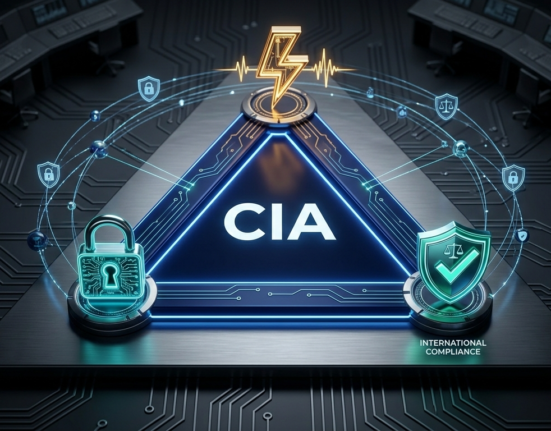
Governance provides the rules, but rules are useless if we don’t understand the fundamental objectives we are trying to protect. Now that we have our compass set, we need to understand the heartbeat of all security infrastructure.
Are you ready to stop thinking about servers and start thinking about data integrity? In our next post, we’ll dismantle the CIA Triad.
Knowledge Check
Question: You discover that a senior executive is bypassing a security control to speed up a project. According to the ISC2 Code of Ethics, what is your primary responsibility?
- A) Ignore the bypass to ensure project deadlines are met.
- B) Report the executive to the IT department for disciplinary action.
- C) Inform the executive of the risk, document the conversation, and seek guidance from governance/management.
- D) Immediately shut down the executive’s access to prevent the breach.
(Hint: Think about your duty to the principal vs. your responsibility to the profession and the organization’s risk posture.)