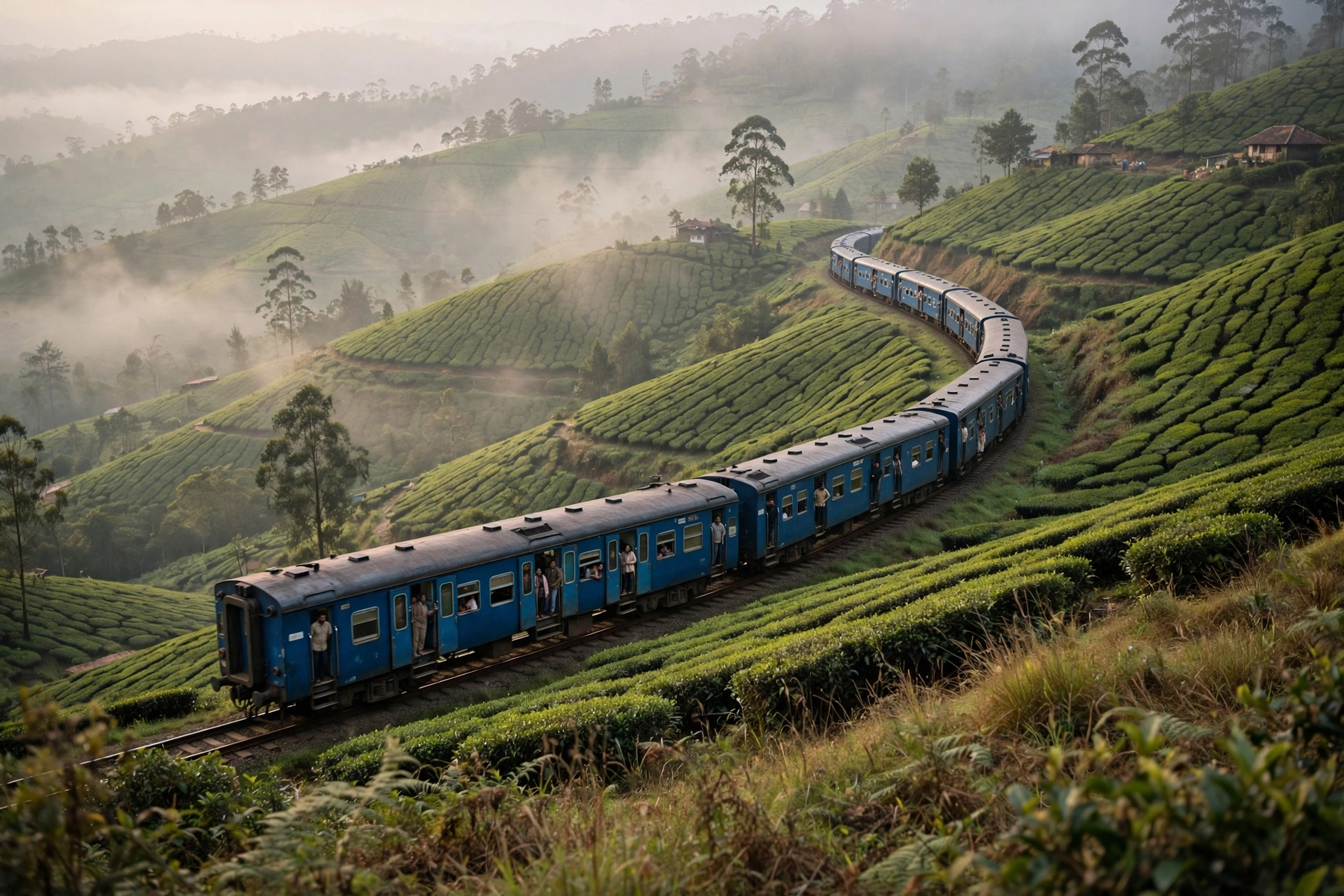
You’ve almost certainly seen the photo before you ever book the ticket: someone leaning out of an open train door, tea plantations rolling past in impossible shades of green, mist hanging low over the hills. It’s become the single most recycled image in Sri Lanka travel content, and it made me deeply skeptical going in. Would the actual experience live up to a photo that’s been reproduced a thousand times over?
Setting Expectations vs. Reality
Here’s the honest version: yes, it’s crowded, especially in second and third class during peak season. Yes, the iconic hanging-out-the-door shot involves real safety risk, and no reputable travel writer should encourage you to lean out over open track at speed for a photo. And yes — despite all of that — it’s still absolutely worth doing. Just not for the reasons the postcard version suggests.
The value isn’t in recreating a single photo. It’s in the accumulated two and a half hours of watching an entire ecosystem shift outside your window: tea estates giving way to eucalyptus forest, small station stops where vendors board with baskets of snacks, and a rhythm to the journey that no bus route through the same hills could replicate.
How to Actually Book This Train (Without the Scalper Markup)
- Book around 30 days in advance through the official Sri Lanka Railways booking system or a trusted third-party platform — first and second class reserved seats sell out fast, especially for the Kandy–Ella or Nanu Oya–Ella stretch.
- Avoid station touts offering “guaranteed seats” for cash. This is almost always a markup on tickets you could secure yourself with a bit of advance planning.
- Second class with reserved seating is the sweet spot. Third class is unreserved and can mean standing for long stretches; the first-class Observation Car is comfortable but closes you off from the open-window experience that makes this ride what it is.
Packing Essentials for Sri Lankan Rail
- A light shawl or sarong. Mornings in the hill country are genuinely cold — a surprise for most first-timers who associate Sri Lanka only with tropical heat.
- Snacks and water. Vendors do board at stops, but selection is inconsistent, so don’t rely entirely on them.
- A dry bag for camera gear. Window seats mean occasional rain spray through tea country, even outside monsoon season.
- Cash in small denominations for onboard vendors, who rarely have change for large notes.
Best Time to Visit vs. Budget Required
| Season | Visibility/Weather | Ticket Cost (2nd class) | Crowd Level |
| Dec–Mar | Clearest views, dry | ~LKR 400–600 | Very high |
| Apr–Jun | Occasional rain, greener | ~LKR 400–600 | Moderate |
| Jul–Sep | Wetter, dramatic mist | ~LKR 400–600 | Lower |
| Oct–Nov | Monsoon transition | ~LKR 400–600 | Lowest |
Interestingly, the ticket price barely moves across seasons — the real trade-off is crowd density versus visibility, not cost. If you can handle a bit of rain, the shoulder months offer a noticeably calmer ride for the same price.
The Stretch That Actually Matters
If you’re short on time, you don’t need to commit to the full Kandy-to-Ella run. The most dramatic scenery — the approach to the Nine Arch Bridge and the tea plantation switchbacks — concentrates in the final 90 minutes into Ella. Joining partway, from a station like Nanu Oya or Haputale, gets you the postcard scenery without the full multi-hour commitment.
From the Field
Somewhere on an unnamed stretch between small stations, an elderly tea estate worker boarded for just a few stops, carrying a sack of freshly picked leaves slung over one shoulder. She sat across the narrow aisle from me, and we had almost no shared language between us — a handful of words, mostly gestures. At some point she produced a battered thermos and poured a small cup of plain black tea, offering it across the aisle without much ceremony.
We didn’t talk, not really. But through gesture alone, she communicated what the harvest cycle looked like that particular week — pointing at the sack, then at the hills outside, then miming the picking motion with her free hand. It was a small, mostly wordless exchange, but it told me more about the region’s actual identity — the labor behind the postcard-green hillsides — than any guidebook paragraph could have.