
🪝 The Hook: A Tale of Three Priorities
Imagine you are the CISO of a large hospital. At 2 a.m., a ransomware attack encrypts your electronic health records system. In that moment, you face an agonising choice:
Do you lock everything down to protect patient privacy — even if it means doctors in the ICU cannot access critical drug dosage records?
Or do you restore access immediately — even before you know whether the data has been tampered with, potentially letting clinicians act on corrupted information?
Welcome to the CIA Triad — the cornerstone of every security decision you will make as a practitioner, and the foundation the CISSP exam will test you on relentlessly.
Here is the uncomfortable truth most study guides won’t tell you: knowing the definitions is not enough. The exam doesn’t ask “what is Confidentiality?” It asks “given this scenario, which control best preserves the correct pillar — and what do you sacrifice in return?”
This post will give you the conceptual depth to answer those questions with confidence. Let’s go.
🏛️ The Foundation: What is the CIA Triad?
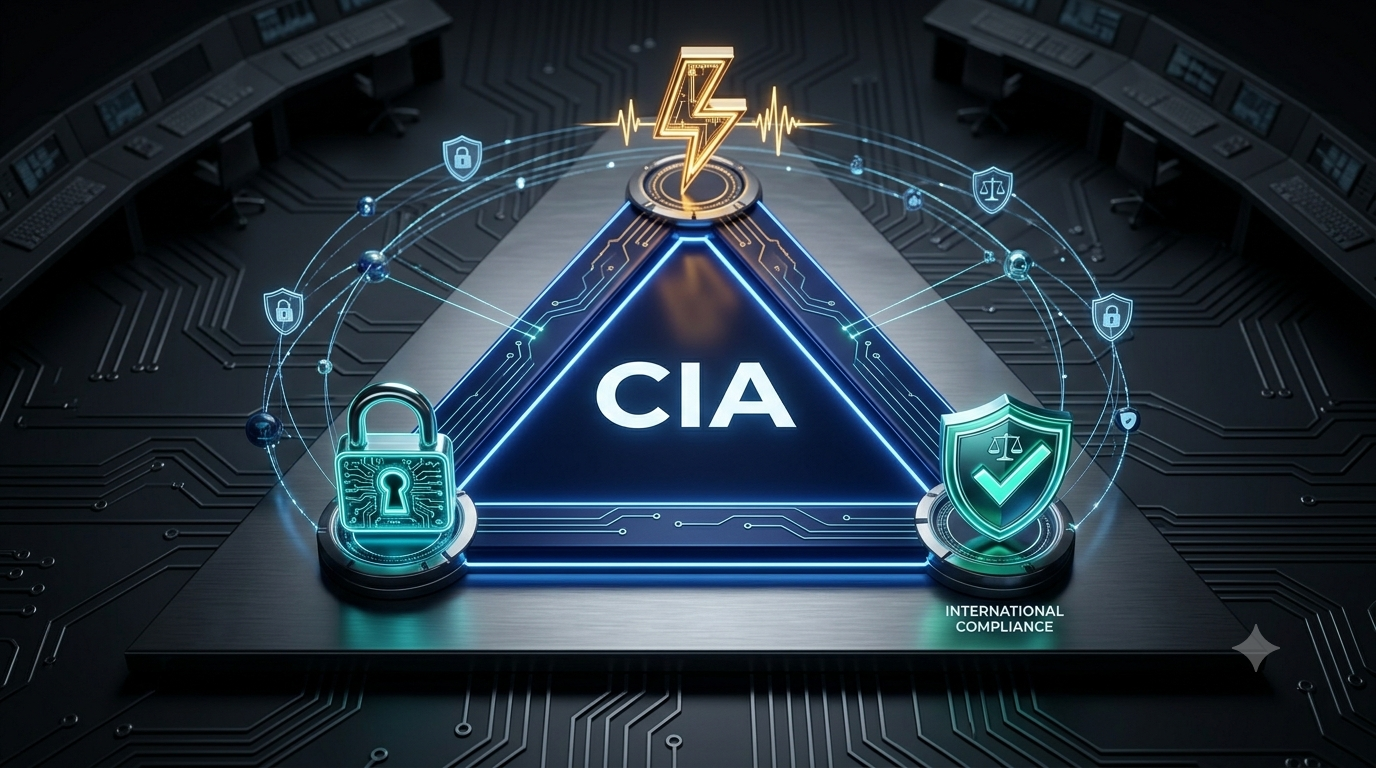
The CIA Triad is the three-pillar model that defines the core objectives of any information security programme. Developed over decades of security practice, it provides a structured lens through which every security control, policy, and risk decision can be evaluated.
Think of it like a three-legged stool. Remove any one leg and the stool — and your security posture — collapses.
| 🔒 CONFIDENTIALITY | ✅ INTEGRITY | ⚡ AVAILABILITY |
|---|---|---|
| GoalKeep data secret fromunauthorised eyes | GoalEnsure data is accurateand untampered | GoalKeep systems accessiblewhen needed |
| Primary ThreatEavesdropping,data leakage | Primary ThreatTampering,corruption | Primary ThreatDoS attacks,hardware failure |
| Key ControlsEncryption, ACLs,data classification | Key ControlsHashing, digitalsignatures, checksums | Key ControlsRedundancy, backups,failover, SLAs |
| ExamplePatient medical recordsencrypted at rest | Example: Bank ledger protected by transaction logs | Example E-commerce site with 99.99% uptime SLA |
| 📖 THE CISSP DEFINITION TO KNOWThe CIA Triad represents the three fundamental security objectives:Confidentiality (preventing unauthorised disclosure), Integrity (preventingunauthorised modification), and Availability (ensuring authorised access when needed).All security controls can be mapped to one or more of these objectives. |
🔒 Pillar One: Confidentiality
The Core Idea
Confidentiality ensures that information is accessible only to those authorised to access it. It is the pillar most candidates naturally understand — but the exam tests its edge cases.
The Analogy
Think of confidentiality as a safe deposit box at a bank. Your valuables are inside. Only you (and those you explicitly authorise) can access them. The bank employee can see the box exists — but cannot open it. The box is locked with a unique key. Without that key, the contents remain private.
Key Mechanisms
- Encryption: Transforms readable data (plaintext) into unreadable ciphertext. AES-256 is the gold standard for data at rest; TLS 1.3 for data in transit.
- Access Control Lists (ACLs): Define exactly who can read, write, or execute specific resources.
- Data Classification: Labels (Public, Internal, Confidential, Secret) help organisations apply appropriate controls at scale.
- Least Privilege: Users receive only the minimum access required for their role — nothing more.
- Need-to-Know: Even within a clearance level, access is further restricted to only what the role demands.
| ⚠️ EXAM TRAP — CONFIDENTIALITY VS. PRIVACYConfidentiality and Privacy are related but distinct. Privacy refers to an individual’sright to control their personal information. Confidentiality is the organisationalobligation to protect that information once collected. An organisation can violateprivacy (by collecting data unlawfully) without violating confidentiality (the datamight still be well-protected). The CISSP exam exploits this distinction. |
✅ Pillar Two: Integrity
The Core Idea
Integrity ensures that data and systems remain accurate, complete, and unaltered except through authorised processes. It protects against both malicious tampering and accidental corruption.
The Analogy
Think of integrity as a wax seal on a royal letter. If you receive an envelope and the seal is broken, you immediately know someone has tampered with the contents — or at least you cannot be certain they haven’t. The seal doesn’t hide the letter (that’s confidentiality); it proves the letter hasn’t been altered in transit.
The Two Dimensions of Integrity
- Data Integrity: Ensuring the data itself has not been modified — accidental or deliberate. Controls include hashing (MD5, SHA-256), checksums, and digital signatures.
- System Integrity: Ensuring operating systems and software run as designed, free from unauthorised modification. Controls include file integrity monitoring (FIM) tools like Tripwire.
Key Mechanisms
- Hashing: A one-way function that produces a fixed-length digest. Any change to the input, no matter how small, produces a completely different hash (the avalanche effect). SHA-256 is the current exam standard.
- Digital Signatures: Combine hashing with asymmetric cryptography to prove both integrity AND authenticity — you know who sent the data and that it hasn’t changed.
- Version Control: Maintains an auditable history of changes to data or code, enabling rollback if corruption occurs.
- Input Validation: Prevents malformed or malicious data from entering a system in the first place.
| ⚠️ EXAM TRAP — INTEGRITY VS. NON-REPUDIATIONNon-repudiation is often confused with integrity. Integrity proves the data wasn’tchanged. Non-repudiation proves who created or sent it, and that they cannot laterdeny doing so. Digital signatures provide BOTH — but they are separate properties.Non-repudiation requires authentication as a prerequisite; integrity does not. |
⚡ Pillar Three: Availability
The Core Idea
Availability ensures that information and systems are accessible and operational when authorised users need them. It is arguably the most underappreciated pillar — until a system goes down during peak hours.
The Analogy
Think of availability like the power grid. You can have perfectly secure, perfectly accurate electricity generation — but if it doesn’t reach homes when needed, it’s worthless. Availability is the delivery mechanism. Redundancy (backup power lines), resilience (circuit breakers), and recovery (generator failover) are its engineering equivalents in information security.
Key Mechanisms
- Redundancy: Eliminate single points of failure. Redundant servers, network links, and power supplies ensure no single component failure brings down the system.
- Backups & Disaster Recovery: Regular, tested backups with defined RPO (Recovery Point Objective) and RTO (Recovery Time Objective) targets.
- Failover Clustering: Automatic switching to standby systems if a primary system fails — transparent to end users.
- DDoS Mitigation: Rate limiting, traffic scrubbing, CDNs, and anycast routing protect against Denial-of-Service attacks.
- Capacity Planning: Ensuring infrastructure can handle peak load without degradation.
| ⚠️ EXAM TRAP — DOS VS. DDOSA Denial-of-Service (DoS) attack comes from a single source. A DistributedDenial-of-Service (DDoS) attack is coordinated across thousands of compromisedmachines (a botnet). The CISSP exam may ask which attack is harder to mitigateand why — DDoS, because blocking a single IP has no effect when traffic arrivesfrom 50,000 different addresses simultaneously. |
⚖️ The Hard Part: CIA Trade-Offs (Where the Exam Lives)
Here is what separates CISSP candidates from CISSP holders: the ability to reason about trade-offs between the three pillars in context.
The exam will present scenarios where maximising one pillar necessarily compromises another. You must identify which pillar takes priority given the organisational context.
Scenario 1: High Security vs. Usability
A financial institution encrypts all internal communications and requires MFA on every action — including approving each individual transaction. Productivity plummets.
- Confidentiality: MAXIMISED — all data is encrypted, access is tightly controlled.
- Availability: COMPROMISED — the friction is so high that legitimate users struggle to do their jobs.
- Lesson: Over-securing a system can create a different kind of availability failure — not from attack, but from design.
Scenario 2: The Hospital at 2 a.m. (Revisited)
Back to our opening scenario. The ransomware attack has hit. What should the CISO prioritise?
- If the ICU needs drug dosage records to save a life: Availability outweighs Confidentiality in this immediate context.
- But if you restore access before verifying data integrity: A doctor might act on corrupted dosage information — potentially causing harm.
- Correct answer: Integrity must be verified before availability can be safely restored. This is a triage, not a binary choice.
Scenario 3: The Whistleblower Case
An employee leaks a confidential internal document exposing regulatory violations. The organisation’s confidentiality controls were breached — but the information itself was accurate.
- Confidentiality: VIOLATED by the disclosure.
- Integrity: INTACT — the data was authentic and unaltered.
- Lesson: Security controls protect the organisation’s posture — but ethics and law operate at a higher level. The CISSP exam will test your understanding of this tension (we cover Ethics in Post 05).
🔬 Going Deeper: The Parkerian Hexad
Donn Parker, a security researcher, argued that the CIA Triad was insufficient and proposed expanding it to six elements, now called the Parkerian Hexad. While the CISSP exam focuses primarily on CIA, understanding the Hexad demonstrates the kind of senior-practitioner thinking that earns full marks on complex scenario questions.
- Confidentiality: As defined above.
- Integrity: As defined above.
- Availability: As defined above.
- Authenticity: Ensuring that data, communications, or identities are genuine — not forged or spoofed.
- Possession / Control: Ensuring that the rightful owner has physical or logical control of the data, even if it hasn’t been disclosed. (Example: a stolen laptop represents a loss of possession, even if the hard drive is encrypted.)
- Utility: Ensuring that data is in a usable format. (Example: data encrypted with a lost key retains confidentiality but has zero utility — it is functionally worthless.)
| 💡 EXAM TIP — WHEN THE HEXAD MATTERSIf an exam question describes a scenario where data is encrypted but the decryptionkey has been permanently lost, the correct analysis is: Confidentiality is intact,but Utility has been destroyed. If a laptop is physically stolen but the drive isencrypted, Confidentiality is intact but Possession has been lost. These distinctionsmatter in advanced scenario questions. |
🎯 The CISSP Exam Mindset: Think Like a Manager, Not a Technician
This is perhaps the most important strategic lesson in this entire series: the CISSP exam is designed to assess managerial and strategic thinking, not technical implementation.
When you see a CIA Triad question, ask yourself:
- What is the BUSINESS context? Healthcare, finance, military, and retail have different priority hierarchies.
- What is the MOST IMPORTANT asset being protected? Patient lives vs. financial records vs. national security shift the calculus.
- What is the RISK of inaction? In life-safety systems, availability often trumps confidentiality. In national security, the reverse is true.
- What is the INTENDED outcome? The best answer is the one that protects the overall mission — not just one pillar.
📋 Quick Reference: CIA Triad at a Glance
- Confidentiality controls: Encryption, ACLs, data classification, least privilege, need-to-know, steganography.
- Integrity controls: Hashing (SHA-256), digital signatures, checksums, FIM, version control, input validation.
- Availability controls: Redundancy, backups (RTO/RPO), failover, load balancing, DDoS mitigation, capacity planning.
- Attacks vs. Confidentiality: Eavesdropping, data exfiltration, shoulder surfing, social engineering.
- Attacks vs. Integrity: Man-in-the-middle, data tampering, SQL injection, malware.
- Attacks vs. Availability: DoS/DDoS, ransomware, hardware failure, power outages, natural disasters.
🧠 Knowledge Check
| ❓ TEST YOUR UNDERSTANDINGScenario: A hospital has implemented full AES-256 encryption on all patient records.During a ransomware incident, the attackers exfiltrate a copy of the encrypted databasebefore the hospital’s detection systems trigger an alert. The encryption keys were NOTcompromised and remain under the hospital’s sole control. Question: Which CIA pillar(s) were violated by the attacker’s actions, and which weresuccessfully defended? Justify your answer. Think it through before reading the answer below. Answer: Availability was partially impacted (ransomware disrupted access). However,Confidentiality was successfully defended — because the encryption keys were notcompromised, the exfiltrated data cannot be deciphered. Integrity was not violated(data was not modified). This scenario illustrates that strong Confidentiality controlscan survive a breach event — a key CISSP principle. |
🌉 The Bridge: What Comes Next
You now understand why the CIA Triad is not a memorisation exercise — it is a decision-making framework that follows you into every corner of the CISSP exam and your career as a security professional.
But here is a question that will haunt you until the next post: who, exactly, is responsible for making these trade-off decisions?
Is it the CISO? The Board of Directors? The IT team? A government regulator? And what happens when their priorities conflict?
In Post 02 — Security Governance Demystified, we pull back the curtain on the governance structures that sit above the CIA Triad — the policies, standards, procedures, and accountability frameworks that determine who decides, who acts, and who answers when something goes wrong.
You will finally understand the difference between a Policy, a Standard, a Procedure, and a Guideline — and why getting this wrong is one of the most common reasons candidates fail Domain 1 questions they thought they had answered correctly.
Post 02 drops next. Don’t miss it. 🚀

1 Comment